2026.08.18
5 hidden logistics costs weighing down your invoices (and how to avoid them)
Read more


Afin de calculer le poids volumétrique de votre pièce, entrez les trois dimensions. Le poids facturé sera le plus élevé entre le poids brut et le poids volumétrique.
Enter your tracking number
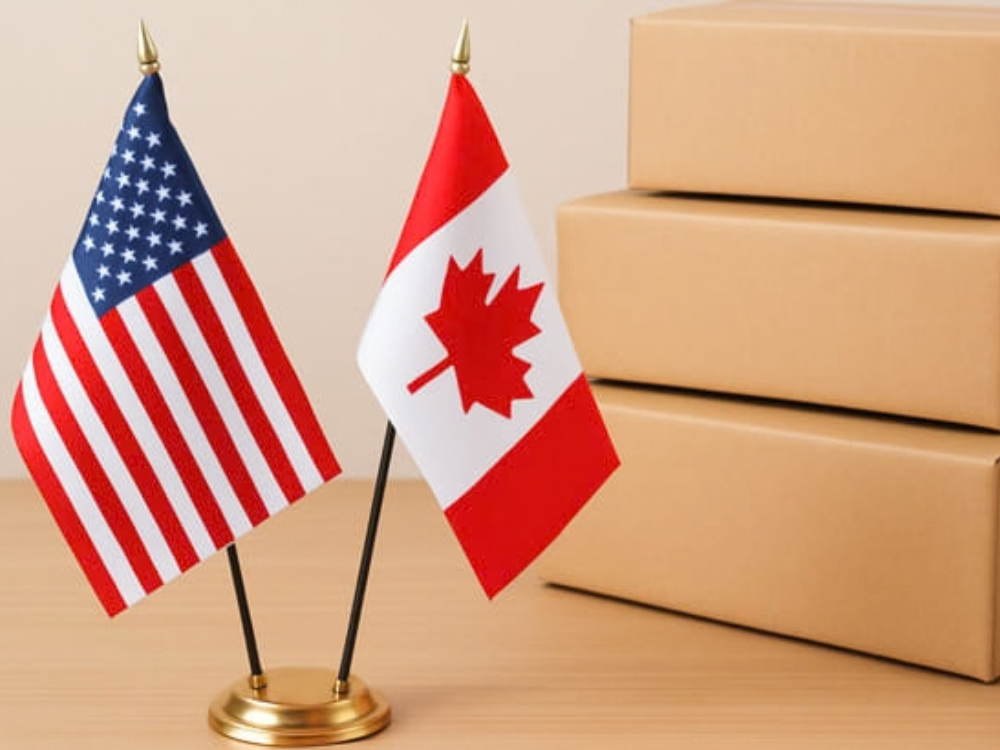
Shipping goods from Canada to the United States requires more than a shipping label. Most commercial shipments need a commercial invoice, an accurate product description, an HS/HTS classification, the country of origin, and a declared customs value. A USMCA certification of origin may also be required when claiming preferential tariff treatment.
Depending on the goods, additional documentation may include a packing list, an air waybill or bill of lading, and permits or declarations required by U.S. regulatory agencies such as the FDA or USDA.
With the suspension of the U.S. de minimis exemption in August 2025 and additional tariff measures introduced in 2026, accurate customs documentation has become even more important, including for low-value shipments.
| Requirement | What you need to know |
|---|---|
| Commercial invoice | Essential for most commercial shipments entering the United States |
| Detailed product description | Must clearly identify the goods, including their material and intended use when relevant |
| HS/HTS classification | Determines tariff classification and helps establish applicable duties |
| Country of origin | The country of shipment is not necessarily the country of origin |
| Customs value | Even free samples may require a declared customs value |
| USMCA | Eligible goods may qualify for preferential tariff treatment |
| De minimis | Shipments valued at $800 USD or less no longer automatically qualify for duty-free entry |
| Regulated products | FDA, USDA/APHIS, or other agency requirements may apply |
| Additional tariffs | Certain goods may be subject to additional U.S. tariffs introduced in 2026 |
Most commercial shipments from Canada to the United States require the following documents and customs information:
Not every shipment requires the same documentation.
The exact requirements depend on the goods being shipped, their origin, value, tariff classification, intended use, and the identity of the U.S. importer.
| Shipment type | Commercial invoice | HS/HTS | Origin | USMCA | Potential additional requirements |
| Goods sold to a U.S. customer | ✓ | ✓ | ✓ | If eligible | Product-specific requirements |
| Commercial samples | ✓ | ✓ | ✓ | If eligible | Product-specific requirements |
| Canadian-manufactured products | ✓ | ✓ | ✓ | Verify eligibility | Product-specific requirements |
| Goods imported into Canada and re-exported | ✓ | ✓ | ✓ | Requires careful assessment | Product-specific requirements |
| Food products | ✓ | ✓ | ✓ | If eligible | FDA / Prior Notice |
| Medical devices | ✓ | ✓ | ✓ | If eligible | FDA requirements |
| Plants and certain agricultural products | ✓ | ✓ | ✓ | If eligible | USDA / APHIS |
U.S. customs requirements and tariff policies have undergone significant changes since 2025.
For Canadian businesses exporting to the United States, three developments deserve particular attention.
Since August 29, 2025, shipments valued at $800 USD or less no longer automatically qualify for duty-free entry under the U.S. de minimis exemption.
Affected shipments are now subject to applicable customs duties, taxes, and fees.
This change has important implications for Canadian e-commerce businesses, manufacturers, and companies shipping commercial samples or replacement parts.
Since July 24, 2026, the United States has imposed an additional 10% tariff under Section 301 on most affected goods, including products imported from Canada.
Goods qualifying for duty-free preferential treatment under the United States–Mexico–Canada Agreement (USMCA) remain exempt from this particular measure.
As a result, verifying USMCA eligibility has become increasingly important for Canadian exporters.
Since August 22, 2026, the United States has also imposed 50% tariffs under Section 338 on certain Canadian products.
Affected categories include selected plastics, furniture, electronics, paper products, industrial machinery, wood products, textiles, and sporting equipment.
Unlike the general Section 301 measure, qualifying for USMCA preferential treatment does not automatically exempt goods from these Section 338 tariffs.
The scope of the affected products was further modified in September 2026.
For most commercial shipments, the commercial invoice is the primary document used for U.S. customs clearance.
It provides U.S. Customs and Border Protection (CBP) and the customs broker with the information needed to identify the goods, establish their value and origin, and determine the appropriate customs treatment.
A properly prepared commercial invoice should generally include:
Generic descriptions can lead to additional customs inquiries and potential clearance delays.
Globex Tip: Your commercial invoice should describe the goods clearly enough for someone unfamiliar with your business to identify what is being shipped.
The Harmonized System (HS) is the international classification system used to identify goods traded across borders.
Its first six digits follow an internationally harmonized structure.
The United States uses the Harmonized Tariff Schedule of the United States (HTSUS) to classify imported goods in greater detail and determine the applicable tariff treatment.
Your product’s classification can affect:
The U.S. tariff schedule is updated regularly.
For example, the U.S. International Trade Commission had published 20 revisions of the 2026 HTS by September 28, 2026, reflecting changes to the U.S. tariff framework throughout the year.
Using an outdated classification or assuming that previously applicable duty rates remain unchanged can expose businesses to unexpected costs.
Globex Tip: Never select an HS code solely because its description appears similar to your product. Material composition, function, manufacturing characteristics, and intended use may all affect classification.
The country a shipment leaves from is not necessarily the country of origin of the goods.
This distinction is particularly important for Canadian distributors, importers, and businesses involved in cross-border e-commerce.
Consider a Montreal-based company that purchases accessories manufactured in China, stores them in a Canadian warehouse, and subsequently sells them to a U.S. customer.
| Information | Country |
| Shipping location | Canada |
| Warehousing location | Canada |
| Destination | United States |
| Country of manufacture | China |
| Potential country of origin | China |
Simply storing, repackaging, or re-exporting products from Canada does not automatically make them Canadian-origin goods.
In 2026, correctly determining the country of origin is particularly important because it can directly affect applicable duties and additional U.S. trade measures.
A USMCA certification of origin is not required simply to ship goods to the United States. It becomes important when preferential tariff treatment is claimed for qualifying goods.
There is a fundamental difference between: shipped from Canada and qualifying for preferential treatment under USMCA.
To qualify, goods must satisfy the agreement’s applicable rules of origin.
Even when a product meets those requirements, preferential treatment is not automatically granted. The importer must claim the applicable treatment and support that claim with the required certification of origin.
For many Canadian exporters, USMCA compliance now has a greater financial impact.
Before the introduction of additional U.S. tariffs, some businesses did not consistently claim preferential treatment because their products already entered the United States at low or zero duty rates.
That situation has changed.
With the introduction of the additional 10% Section 301 tariff, determining whether goods qualify for duty-free preferential treatment under USMCA has become more important.
The Importer of Record (IOR) is the party responsible for customs entry and the import compliance obligations associated with that entry.
Identifying the IOR before shipping is especially important when a Canadian business sells directly to U.S. customers.
The parties involved should establish:
Under DAP (Delivered at Place), the seller generally arranges transportation to the agreed destination, while the buyer is normally responsible for import customs clearance and the associated duties.
Under DDP (Delivered Duty Paid), the seller assumes broader responsibility for import formalities and associated costs.
In 2026, preparing a Canada-to-USA shipment involves much more than attaching a commercial invoice to a package.
With over 30 years of experience in domestic and international transportation, Globex Worldwide Courier helps Canadian businesses manage their shipping needs to the United States, from time-sensitive parcels and recurring commercial shipments to regulated goods and more complex freight movements.
Shipping to the United States and unsure which documents you need?
Speak with a Globex shipping specialist before your next shipment.
1) Can I ship a package from Canada to the USA without a commercial invoice?
For commercial shipments, a commercial invoice or equivalent customs information is generally required. Exact documentation requirements depend on the goods, the nature of the shipment and the applicable customs entry procedures.
2) What is the difference between an HS Code and an HTS Code?
The Harmonized System (HS) is the international classification framework, with six-digit codes harmonized internationally. The U.S. Harmonized Tariff Schedule (HTSUS) provides the more detailed classifications used to determine the tariff treatment of goods imported into the United States.
3) Can I declare a free sample with a customs value of $0?
Not automatically. A free sample may still have a value for customs purposes. Its description and declared value must accurately reflect the goods and comply with applicable customs valuation rules.
4) How can I calculate U.S. import duties on goods shipped from Canada?
To determine potential U.S. import duties, you generally need the product’s HTS classification, actual country of origin, customs value, potential USMCA eligibility and any additional tariffs in effect at the time of importation.
5) Can a Canadian business ship DDP to the United States?
Depending on its import arrangements, a Canadian business may be able to ship under Delivered Duty Paid terms. However, it must first determine how the Importer of Record requirements, customs brokerage arrangements, duties and other U.S. import compliance obligations will be handled. Choosing an Incoterm does not, by itself, resolve those regulatory obligations.

2026.08.18

2026.07.31

2026.07.09