2026.10.09
Dimensional Weight: how to calculate it and determine your true shipping cost
Read more


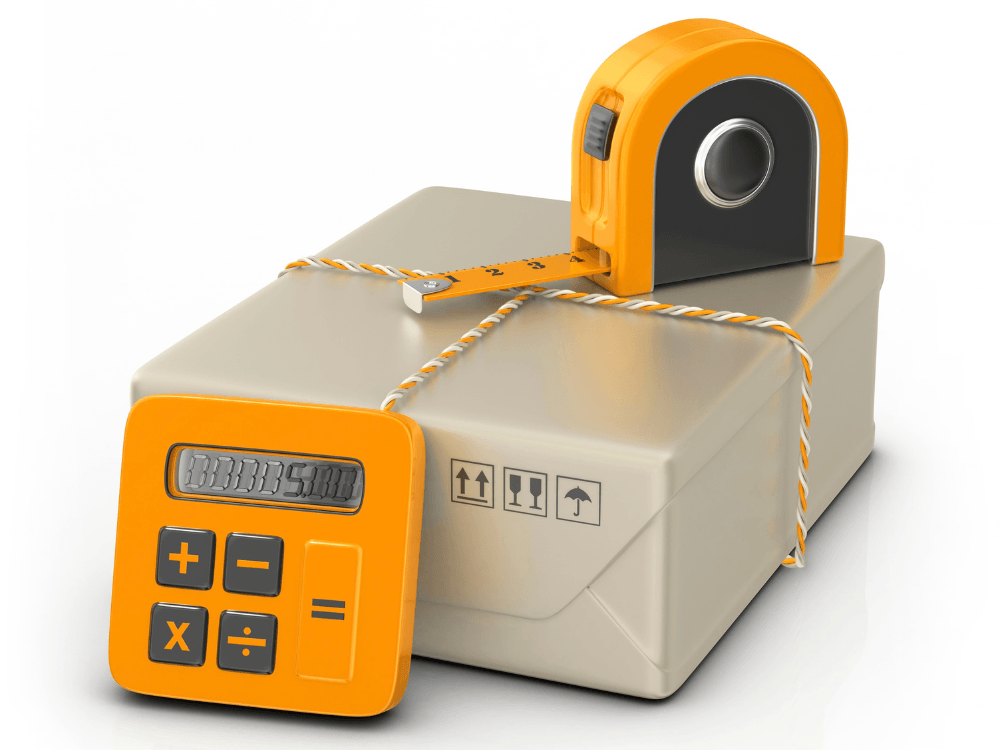
Afin de calculer le poids volumétrique de votre pièce, entrez les trois dimensions. Le poids facturé sera le plus élevé entre le poids brut et le poids volumétrique.
Enter your tracking number
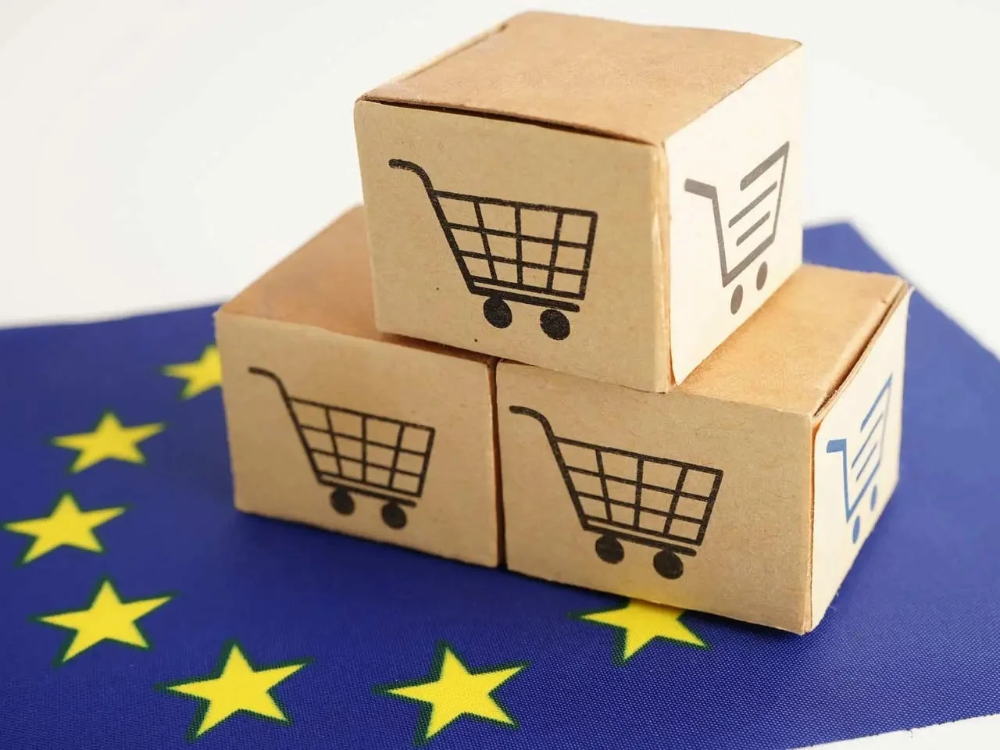
As part of the European Union (EU) customs reform, new import rules are in place to strengthen product safety and streamline border clearance. To comply with these EU customs requirements, product identifiers (PIDs) are now a mandatory regulatory requirement for all companies shipping goods from a business to a consumer (B2C) into Europe with an intrinsic value of €150 or less.
These requirements apply to all shipments that meet all of the following criteria:
Note: Business-to-business (B2B) shipments destined for businesses registered for VAT in the EU are not subject to the PID requirement.
For each item in your shipment, European customs authorities require up to three distinct alphanumeric codes:
| Identifier Type | Description | Examples | Status |
|---|---|---|---|
| M-PID (Merchant PID) | Internal reference or SKU assigned by the seller to track the product in their system. | SKU-4853, TOTE-WHITE-01 | Mandatory |
| NS-PID (Non-Standardized Manufacturer PID) | Model or part number assigned by the manufacturer or supplier | MX2000, FKS453-BLK | Mandatory |
| S-PID (Standardized Manufacturer PID) | Globally recognized standard code (e.g., barcode). | UPC, EAN, GTIN (5012345678900), ISBN | Mandatory if it exists (indicate “NONE” otherwise) |
Do:
Don’t:
Warning: Transmitting incomplete customs data prevents brokers and customs authorities from clearing your packages. This can lead to significant delays upon arrival in Europe, additional administrative or storage fees, or even an automatic Return to Origin (RTO) at the shipper’s expense.
To make this regulatory transition friction-free, our client portal features an intelligent system designed to automate and simplify product identifier management:
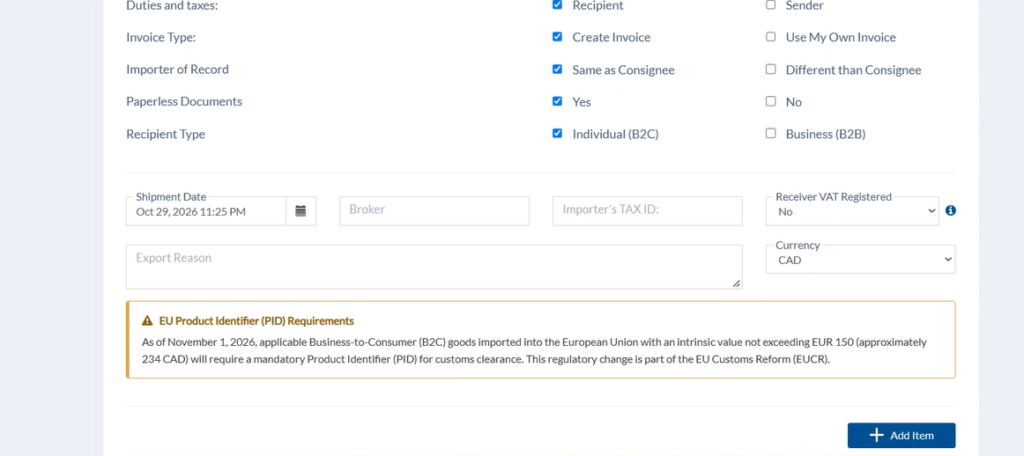
1) Automatic Detection & First Alert: As soon as you enter your order, the portal instantly identifies if your shipment targets the European Union under a B2C sale with an eligible value. A clear informational banner appears directly on screen to remind you of current obligations.
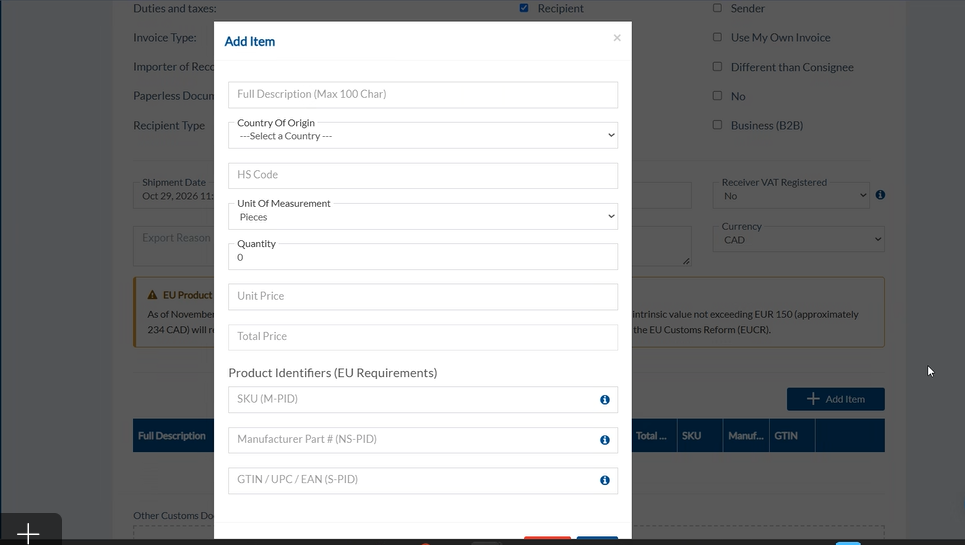
2) Dedicated Fields per Item: When adding your items, the system provides specific, structured fields so you can easily enter your codes (M-PID, NS-PID, and S-PID).
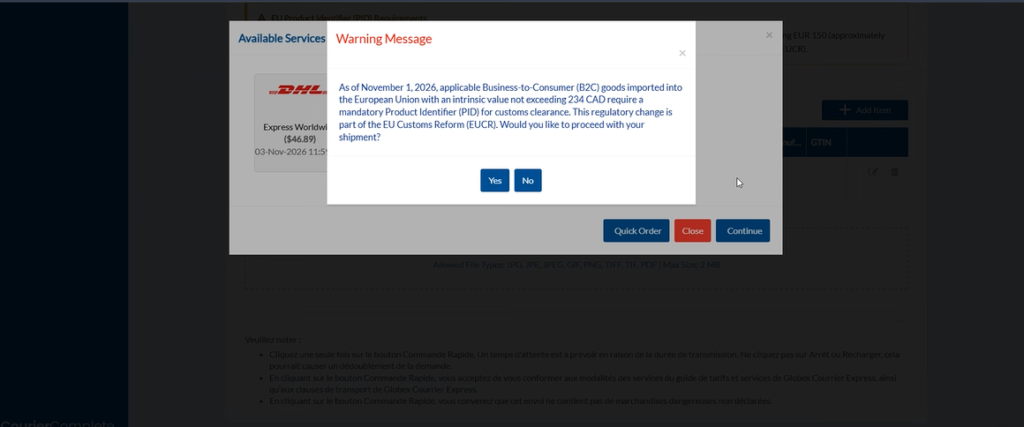
3) Enhanced Security (Double Alert): If no identifiers were provided during the initial step, an intelligent pop-up alert triggers at the time of service selection to warn you and prevent any clearance-blocking omissions.
1) What happens if my B2C shipment contains multiple items of varying values whose total exceeds €150?
The Product Identifier (PID) requirement applies when the total intrinsic value of the shipment does not exceed €150. If your overall shipment exceeds this threshold, standard customs clearance rules apply and PIDs are not mandatory at the line-item level for that specific shipment.
2) Do I need to provide PIDs if my goods transit through the EU for delivery to a third-party country?
No. The requirement to transmit PIDs applies exclusively to goods whose final import destination is within an EU member state as part of a sale to a consumer.
3) How can I obtain or generate an S-PID if my product does not have an official barcode?
If your item does not possess any internationally recognized standard code (such as a UPC, EAN, GTIN, or ISBN), you do not need to invent one. Simply enter “NONE” in the dedicated S-PID field, as outlined in customs guidelines.
4) Do online marketplaces automatically transmit PIDs on my behalf?
Not necessarily. Even if you sell through an external platform, the responsibility of determining and providing accurate PID codes during shipping rests with the shipper. It is your responsibility to synchronize your catalogues so these data points are integrated into your Globex order flows.